Monday, June 18, 2012

Facebook to Let Advertisers Bid on Ads Using Your Browser Data

Facebook is expected to introduce real-time bidding as a feature to their advertising. This is something that Google has done for years, which legs advertisers use browsing history to target users.
Facebook Exchange, the bidding feature, is projected to be launched in a few weeks. Facebook is currently working with eight different firms, such as Turn, TellApart, MediaMath, DataXu, AdRoll, Triggit, and The Trade Desk, to create this feature. Facebook has just begun to include cookies to track users by their browsers. Third parties will match information from other sites with those cookies. If a user searches for “truck,” and then goes onto Facebook, advertisers in the auto industry will be able to show that user ads on Facebook for trucks.

Although Facebook’s traditional advertising is very successful, the new changes will allow for advertisers to achieve more impact and insight, more quickly, at a smaller cost. Facebook already leads the U.S. display ad market, with a 14% share in 2011, and is expected to rise to 16.8% in 2012.  

Wednesday, June 6, 2012

5 Hot Facebook Marketing Trends


Facebook has drastically changed in the past year, and marketing on it has changed as well. The image-heavy Facebook timeline has made many changes for how businesses market their products and services through the social media site.  There is an impressive amount of pressure on Facebook to be advertising friendly, and a lot of this comes from the fact that with its 133 million users, it can potentially have a bigger audience than the Super Bowl.

The first marketing trend the new Facebook has is the ability to post more and larger photos. Consumers are getting used to a more image filled web, so the new Facebook design features much bigger pictures than before. An analytics firm that measures brand performance, Simply Measured, confirmed a 65% jump for photos and videos combined that companies posted on their Facebook timelines. Sprinkles Cupcakes is a strong believer in the effectiveness of posting photos and videos to their Facebook page, especially with a call to action, seeing the number of likes and comments triple when one exists.

The second trend Facebook timeline has is tapping real-time data. Businesses now have the ability to immediately see the success of their campaign, while typically you have to measure the results at some point in order to see if the ads are working or not. This past April 17th on Tax Day, TurboTax saw their Facebook post on “Most Common Tax Questions” doing well on Facebook’s “People Talking About This” page, so in turn they advertised on Facebook to increase the reach of the post.

The third trend is to use your Timeline cover photo for marketing. With the cover photo being a giant picture at the top of the company’s Facebook page, brans are realizing this photo can be a banner ad. The huge image provides instant exposure to all of the brands Facebook fans. Other brands are using the cover photo as an interactive photo for their fans. With different call to actions, such as posting a question on the image, fans can now interact with the cover photo.

The fourth trend the Facebook timeline creates for marketing is the gamification of posts. Coca-cola is a very well-known brand on Facebook.  Coca-cola has been posting URL riddles to its millions of fans. Along with them, JetBlue has also been posting more interesting and interactive posts such as “Fill in the Blank” status updates. JetBlue received 182% more comments per most than other typical brands with their post gamification method.

The fifth and final trend on the new Facebook timeline is creatively saying ‘Thank You’. By coming up with creative ways to thank your fans, you can single out and give your fans praise while entertaining the rest of the fans, who normally would have been uninterested in the post. Kraft Mac & Cheese did this by posting a 7-minute video thanking 4,800 fans who had “liked” a post of theirs. The video consisted of a song which included each of their individual names. The 4,800 fans were individually thanked, and the rest of the fans were still entertained in the process.

Tuesday, May 15, 2012

General Motors Quits Facebook Advertising


General Motors is pulling ads from Facebook, calling them “ineffective”, according to a Wall Street Journal report. It was determined that their ads on the platform “had little impact on consumers,” according to the report. However, GM will continue to market via Facebook’s free brand pages.

The article quotes GM marketing chief Joel Ewanick as saying GM “is definitely reassessing our advertising on Facebook, although the content is effective and important.” Ewanick’s use of “content” in this case refers to Facebook brand Pages.

GM spends about $40 million marketing on Facebook, but only about a quarter goes to advertising- the rest going to creating content for the site, according to the report. GM spends an estimated $1.8 billion worldwide on advertising per year.

A Forrester Research Analyst, Nate Elliott, wrote a blog post on Monday questioning the social network’s advertising. “Somehow Facebook still hasn’t stumbled upon a model that’s proven consistently successful for marketers, or that brings in the massive revenues to match the site’s massive user base,” wrote Elliott. “One global consumer goods company told us recently that Facebook was getting worse, rather than better, at helping marketers succeed. And companies in industries from consumer electronics to financial services tell us they’re no longer sure Facebook is the best place to dedicate their social marketing budget – a shocking fact given the site’s dominance among users.”

Facebook posted revenues of $3.7 billion in 2011, the vast majority of which came from advertising. However, Facebook’s first-quarter revenues fell from the previous quarter and Facebook’s amended S-1 form, filed on May 10, cited the transition to mobile as a worrisome sign for ad revenues.

Wednesday, May 2, 2012

Will 2012 see growth in online ads?


From Online Media Daily: Just as gadget-crazed as consumers, advertisers are expected to accelerate their nontraditional media spends through 2012. MagnaGlobal now expects spending on Internet media (including national and local) to grow by 12.2%, this year. That’s up from the Interpublic unit’s previous forecasts of 10.9%, and, if correct, will represent $35.6 billion and a 20.2% market share.

“Encouraged by the rise of smartphone and tablet usage and the availability of scalable platforms, mainstream advertisers are now fully embracing all mobile formats (display, search, video, in-app),” said Vincent Letang, EVP and head of global forecasting at MagnaGlobal.

Letang expects mobile-related online ad revenues to grow by 53% in 2012, to reach $2.4 bil. “iAd and Facebook in particular will create more opportunities for marketers in various mobile environments in 2012,” he said. With $1.6 billion in 2011, mobile advertising already represents 5% of online advertising, and 1% of total domestic advertising.
That said, Internet media is still driven by paid search, as well as online video, which Letang expects to grow by 24% in 2012 to reach $2.2 billion.

In terms of advertising sectors, technology, finance and telecoms are expected to increase their respective expenditure at higher than average rates, according to the company.

Automotive remains a concern, but more for traditional media buyers, MagnaGlobal notes. In 2010, and again in 2011, a double-digit recovery in car sales was matched by a double-digit growth in automotive ad spend. Going into 2012, however, while new car sales were up in the first quarter, protracted unemployment and steep gasoline inflation could hamper further growth.

Read more: http://www.mediapost.com/publications/article/173666/new-online-ad-forecast-12-growth-for-2012.html#ixzz1tjoq8epQ

Wednesday, April 18, 2012

Marketers are making their way onto Pinterest


More and more research being released shows that social media is taking over and it’s a great way to help market and advertise brands. Pinterest is one of the newest social media outlets being utilized by marketers. Magazines like Better Homes and Gardens and marketers like Whole Foods have been quick to embrace Pinterest, the start-up firm that allows its users to share images by “pinning” them.

The site’s popularity among brands is noted as a prime example of the rise of visual web, along with Instagram and Facebook’s new time line feature, which like Pinterest, is heavily driven by images instead of text.

Andrew Lipsman is the vice president of industry analysis research firm comScore said, “Pinterest is creating sort of a meritocracy of what’s visually appealing. Brands are scrambling and trying to figure it out. They know it’s going to be big, but they don’t necessarily know the best way to use it.”

Better Homes and Gardens has 73 pin boards on Pinterest with a total of 47,854 people who follow them. Images from these boards were “re-pinned” (another feature of the site) on other boards 448,022 times in January alone. “To me, it’s an ideal platform for brands like ours that are really visually driven in many ways,” said Gayle Butler, the editor in chief of Better Homes and Gardens.
Another way that images make their way across the Web to Pinterest is through the “Pin It” button that is slowly making its way alongside the Facebook and Twitter share buttons that live near most digital material.
While the company does not provide any user data to publishers of brands, we do know that it is at the forefront of social media and that Pinterest is a great way to further build a brand.  

Wednesday, March 21, 2012

Happy Birthday, Twitter!


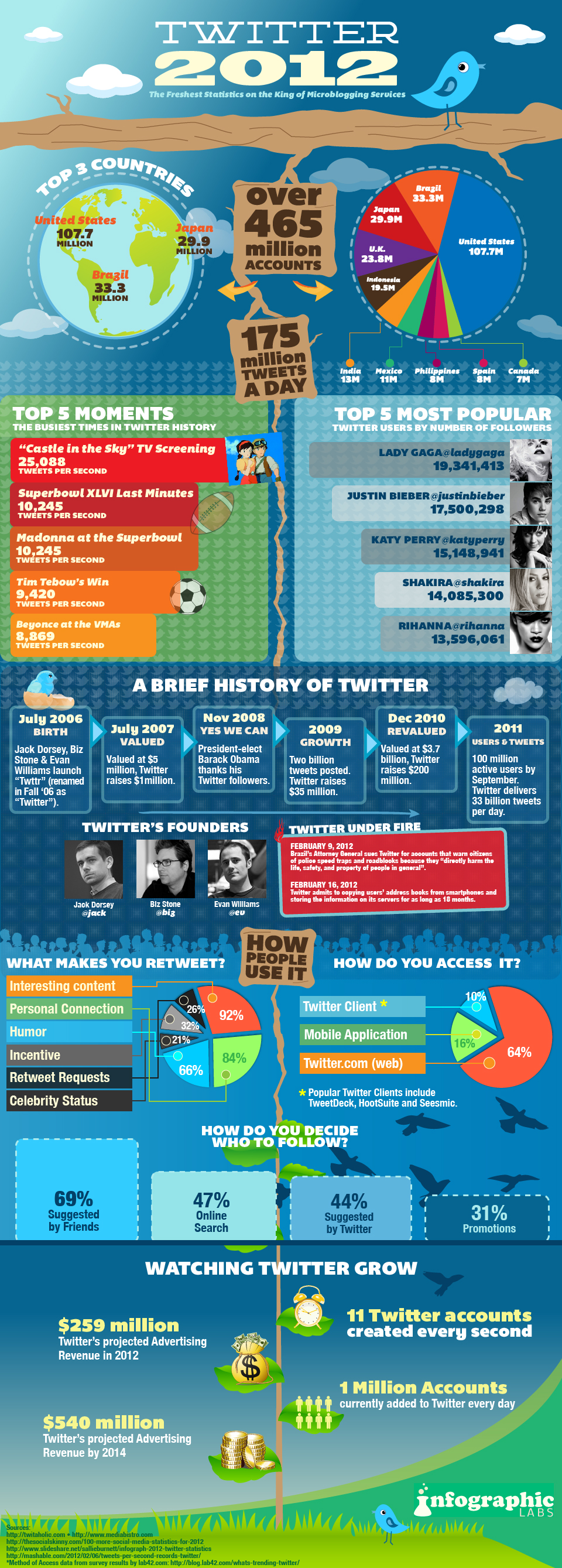
Six years ago today, Jack Dorsey tweeted the first ever tweet on Twitter and a communications revolution was born.
Now, 6 years later it has grown exponentially to over 500 million users, making it the largest one-to-many open communication platform on the web today.  After hearing those numbers you would never believe what humble beginnings this social network came from.
Twitter stemmed from an earlier company ran by ex-googler friends called Odeo, which was going to be a podcasting platform. But when Apple launched iTunes podcasting, it made their little startup company irrelevant. After enlisting the help of another buddy and much brainstorming, the team came up with “Twttr”, which would eventually become Twitter.
This social networking phenomenon allows its users to interact with their favorite celebs and follow the latest news s
tories. Many businesses use Twitter as a marketing tool to reach consumers. It has changed media, business and politics – even our President Barack Obama has an account!
With 11 Twitter accounts created every second, the company is projected to earn $259 million in Advertising Revenue this year. Not a bad birthday gift!